Charging network connectivity
Put your chargers in front of more drivers, on your terms
Publish locations, tariffs and availability to Hub once. Every app you agree to roam with receives them in its own OCPI version, and only where your visibility rules allow.
The partner portal: each partner sees its own data, and only its own. Synthetic demo data.
- Partner isolation: a partner never sees another partner’s data
The challenge
The distribution problem
A charger that drivers cannot find in their app earns nothing. Building integrations with each app is out of reach for most networks.
Invisible chargers
Drivers search in the app they already use. If your chargers are not there, they drive past.
Your own app is not enough
Few drivers install a separate app for every network they might use.
Losing control
Operators worry that sharing data means losing control over who sees private or fleet sites.
How it works
From your back office to participating apps
Step 1: Publish once
Send locations, EVSE status and tariffs to Hub over OCPI, as you would to any partner.
Step 2: Choose who sees what
Roaming agreements and visibility rules decide which apps receive each location. Private and home sites stay hidden by default.
Step 3: Hub distributes
Updates go to every eligible app, translated to its version, through the shared delivery queue.
Step 4: Withdraw any time
Unpublish a site or narrow a rule and apps that may no longer see it receive a withdrawal.
Interactive illustration
Data visibility controls
Change the operator’s settings and watch the visibility rules decide.
Will this app see this location?
Change the CPO’s settings and watch Hub’s visibility rules decide, in their fixed order. The first rule that applies decides.
- Explicit deny rule for this appno: continue
- Private or home locationpublic: continue
- Explicit allow rule for this appno: continue
- Roaming agreement in force for Locationsshare
- Defaultnot reached
Shared with the app
The roaming agreement covers Locations, and the location is public.
Illustration of Hub’s visibility precedence. Staff can run the same decision for a real location in the decision tester without changing anything.
Capabilities
Built for operators
Platform partners
A back office that serves many operators connects once and lists each operator as its own party with its own agreements.
Live availability
EVSE and connector status updates relayed as partial updates where the receiver supports them.
Your price passes through
Your tariff reaches apps unchanged. The app sets its own driver price after Hub.
Delivery visibility
See what Hub delivered to whom, what failed and why, and retry once fixed.
Connection health
Health per OCPI module, with stale data flagged.
Tariff-checked records
Your charge records are checked against your own tariff before they reach apps.
In the product
Charging network connectivity in Getz Hub
Captured from the running Hub with synthetic demonstration data: names, counts and amounts are not real partners or traffic.
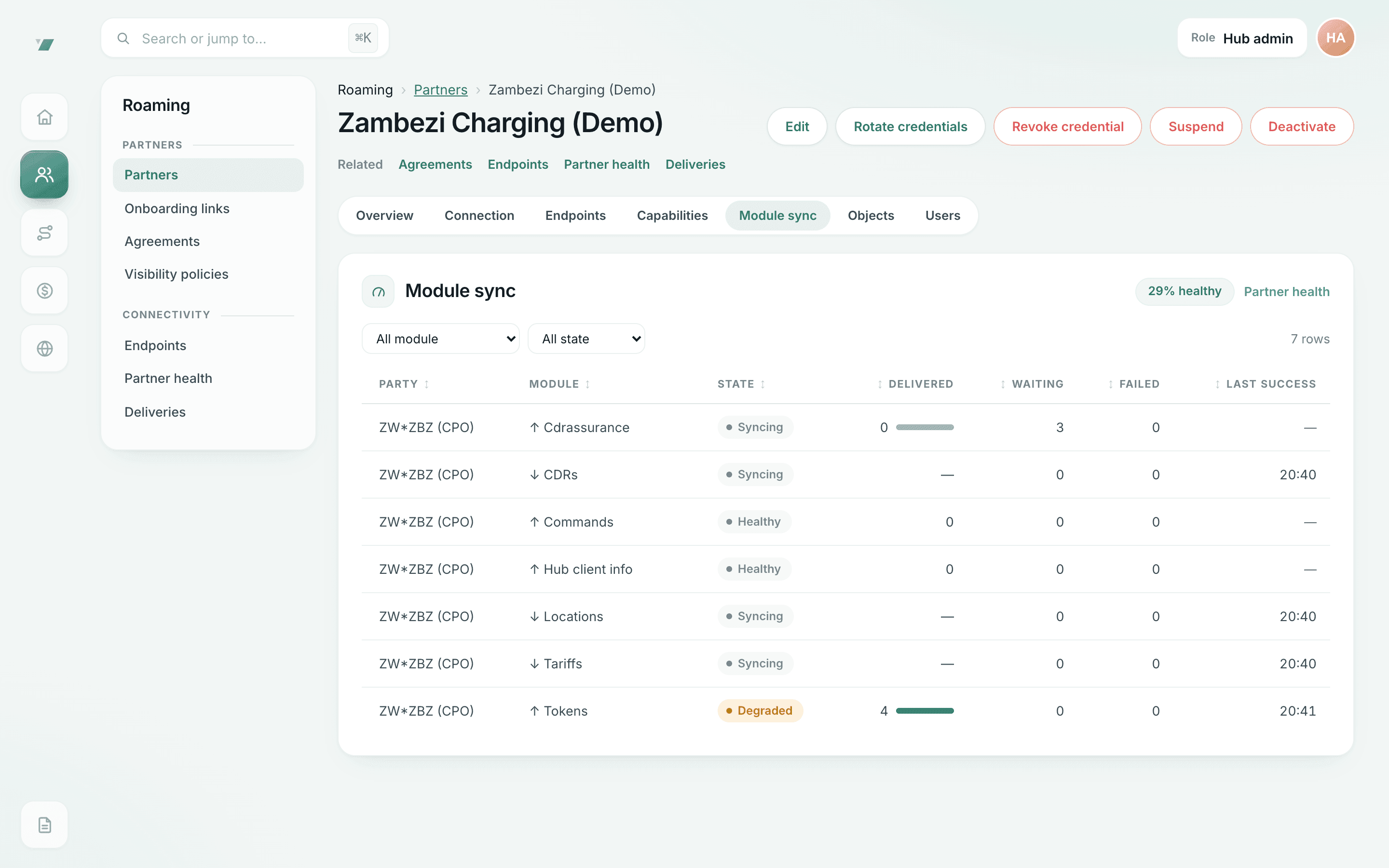
Delivery health per OCPI module
What was delivered, what is waiting and what failed, per module.
- Degraded modules are flagged with the reason; staff can requeue failed deliveries
- Inbound counts are compared only where the sender reports its own counts
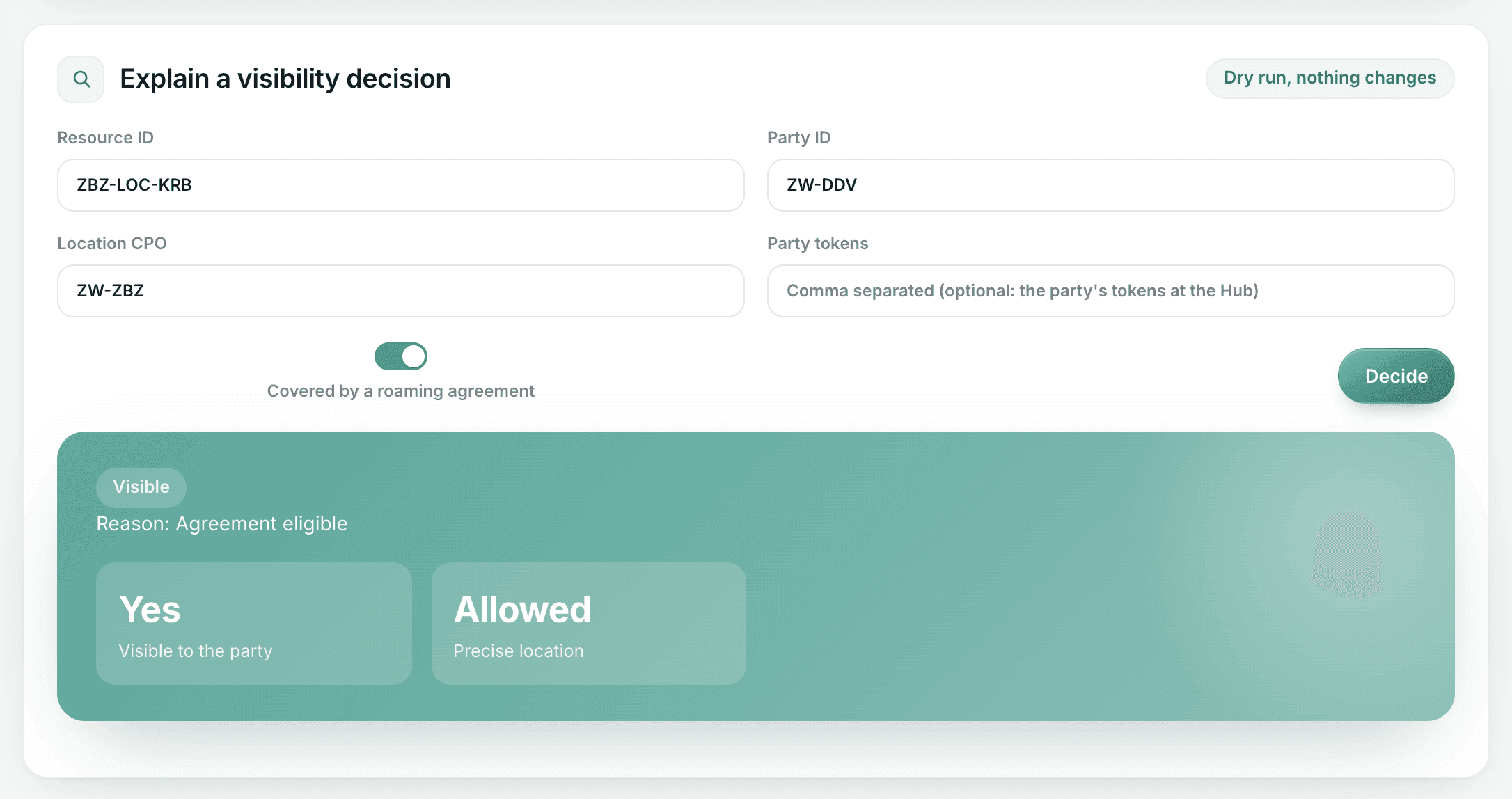
Test a visibility rule
See whether a party may see a location, and why, without changing anything.
- Dry run: nothing changes
- Home and private locations stay hidden by default
Coming soon
Your chargers on partners’ websites, straight from Hub.
- Coming soon
A hosted "chargers near you" map widget for partner websites
Drop in a map of public chargers, with no map hosting of your own.
Questions
Charging network connectivity: questions
Will connecting expose our drivers to competitors?
Hub routes sessions and charge records only between the operator and the app that owns the driver’s token. Partner data is isolated; no other partner sees it.
Can we keep fleet or private sites off public apps?
Yes. Unpublished sites are never shared unless you allow a specific driver token, and you can deny or allow named apps per location.
What does distribution through Hub cost an operator?
Joining Hub and publishing chargers costs operators nothing. The party that starts a roamed session pays its fee, usually the app. The pricing model. We do not forecast extra sessions for your network; ask us which counterparties are relevant to you.
Which apps receive our locations?
Only apps with a roaming agreement in force with you, or that your rules name. App teams can read how they propose agreements on the EV charging apps page.
What if the counts in the module sync do not match?
The partner portal shows delivery health per module and flags stale data. Once you have fixed the cause, you can retry your failed deliveries yourself. Message routing and retries.
Can our sites appear in a car brand’s owner app?
Yes, if the owner app connects as an app and you accept its roaming agreement. Automotive options.
Reach more drivers without building more integrations
Tell us about your network and back office. We reply by e-mail.