EV roaming infrastructure
EV roaming without one integration per partner
Getz Hub sits between charge point operators and the apps drivers use. Each side connects once over OCPI; Hub routes locations, tokens, sessions, commands and charge records between partners that have agreed to roam with each other.
Roaming agreements: which partners roam together, for which OCPI modules, from when. Synthetic demo data.
- An agreement routes only once both sides accept the same revision
The challenge
What roaming costs without a hub
Peer-to-peer roaming works, but each connection is its own project. For a market with many small networks, that maths keeps most of them unconnected.
N × M integrations
Ten operators and five apps need fifty bilateral connections to reach each other. Through a hub they need fifteen.
Every partner is different
Versions, module support and quirks differ per partner, and each one has to be tested separately.
Operations multiply
Credentials, monitoring and failed deliveries have to be handled for every connection on its own.
How it works
How roaming through Hub works
Step 1: Connect once
Onboard through a self-service link and complete the OCPI credentials handshake in the version you already run.
Step 2: Agree who you roam with
Propose or accept roaming agreements per partner and per OCPI module. Nothing flows without one.
Step 3: Publish or consume
Operators publish locations and tariffs once; Hub delivers them to every app allowed to see them. Apps share tokens and start sessions the same way.
Step 4: Settle on checked records
Charge records are checked against the agreed tariff before they reach the app; mismatches are held.
Interactive illustration
A roaming transaction, end to end
Follow one roamed charging session through Hub, message by message.
One roamed charging session, end to end
A driver of one app charges at another operator’s charger. Follow the OCPI messages through Hub.
The CPO publishes its location and tariff
The CPO pushes locations and tariffs once. Hub delivers them to each app it has a roaming agreement with, if the CPO’s visibility rules allow that app to see the location.
Illustration of the OCPI message flow through Hub. It shows how Hub routes messages; it is not a live simulation and does not show the app’s own driver pricing, which happens after Hub.
Capabilities
What you get
All the roaming modules
Locations, Tariffs, Tokens with real-time authorisation, Sessions, CDRs and Commands, in OCPI 2.1.1, 2.2.1 and 2.3.0.
Routing you can explain
Direct, broadcast and open routing with a decision trace for every outcome.
Remote commands
Start and stop sessions from the app; results are relayed back and timeouts reported once.
Autocharge vehicle IDs
A car’s vehicle ID can roam as an ordinary OCPI token. If two apps claim the same vehicle ID, Hub refuses to guess.
Tariff-checked records
Charge records re-priced from the operator’s tariff; mismatches held from the app.
Self-service operations
Partners see their own deliveries, retry failures and check connection health in the portal.
In the product
EV roaming infrastructure in Getz Hub
Captured from the running Hub with synthetic demonstration data: names, counts and amounts are not real partners or traffic.
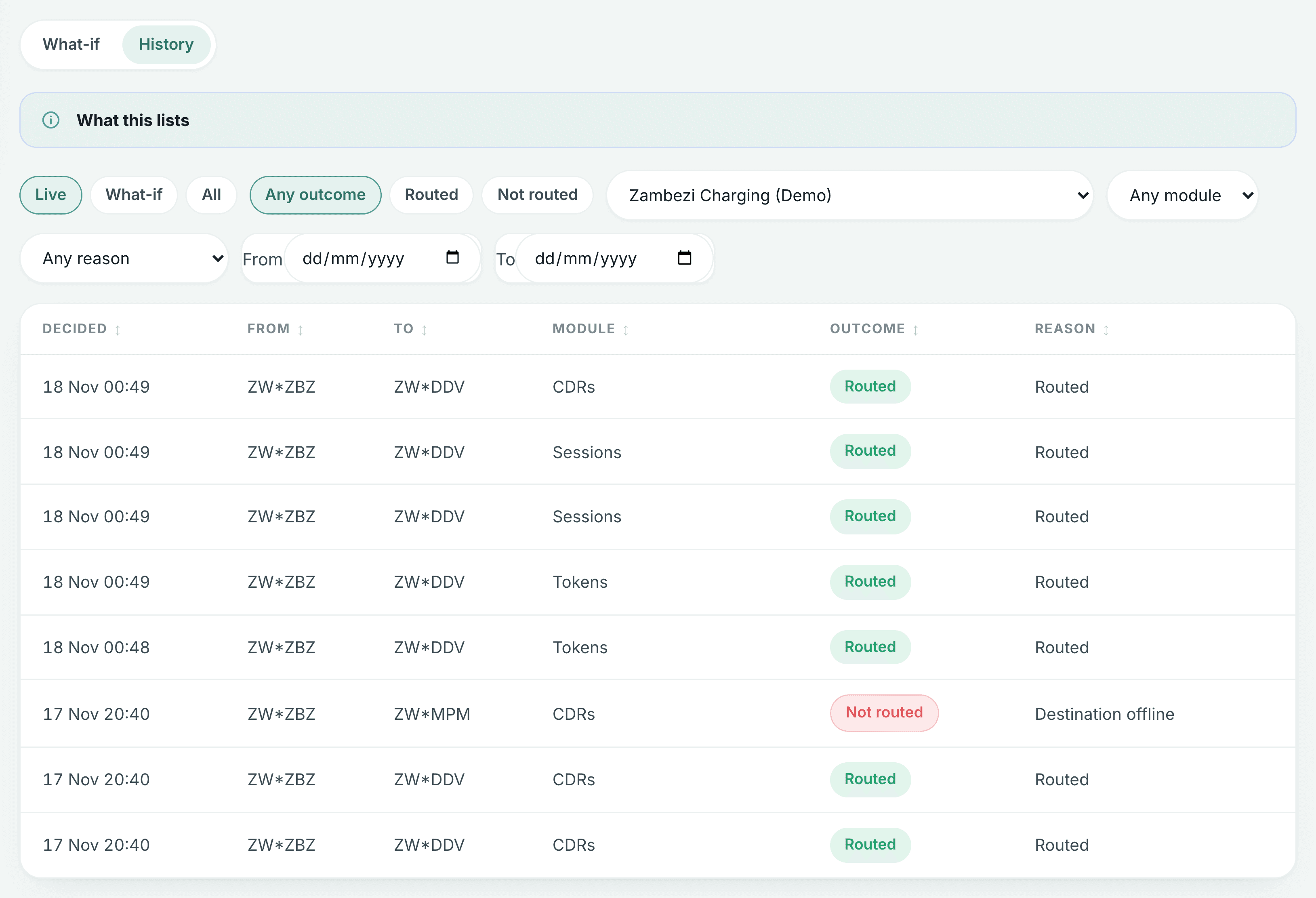
Every message, where it went and why
Routing decisions per partner: sender, receiver, OCPI module and outcome.
- What you see: routing decisions for one demo partner, by module and outcome
- Why it matters: any delivery can be traced back to the decision behind it
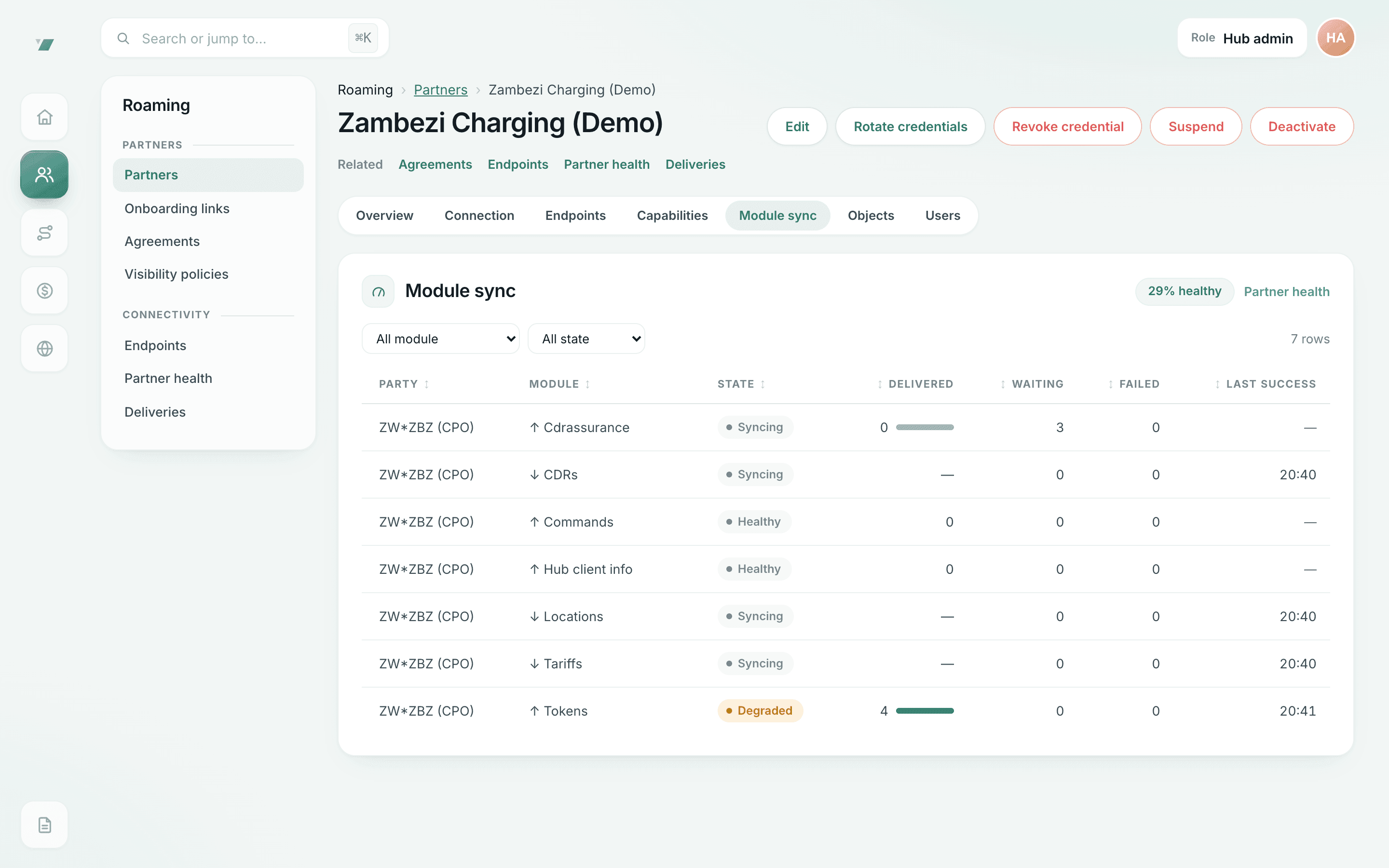
Delivery health per OCPI module
What was delivered, what is waiting and what failed, per module.
- Degraded modules are flagged with the reason; staff can requeue failed deliveries
- Inbound counts are compared only where the sender reports its own counts
Coming soon
Roaming that keeps working when a link is down.
- Coming soon
Starting a charge when the app or the hub cannot be reached
Sessions that start even when the app or Hub cannot be reached.
Questions
EV roaming infrastructure: questions
What is EV roaming?
EV roaming lets a driver use one app or card to charge on networks run by other operators. The operator and the driver’s app (the eMSP) exchange locations, authorisations, sessions and charge records, usually over the OCPI protocol.
We already have our own driver app. Do we have to give it up?
No. Keep it. Connecting to Hub only adds other apps’ drivers to your chargers, under agreements you accept. Your base price passes through unchanged; the app sets its own driver price after Hub.
Will we reach every charging network?
You reach participating networks and apps: those connected to Hub that agree to roam with you. Coverage grows as partners join; we do not publish coverage figures before they exist. Ask which networks are available for your market and agreement.
As an operator, who can discover our sites?
Only the apps you have a roaming agreement in force with, or that your visibility rules name. Before an agreement, an app sees nothing of yours. Visibility and privacy controls.
Does this cover remote start from a car brand’s owner app?
Yes: an owner app connects as an eMSP and starts sessions through Hub like any app. The automotive page explains the owner-app, in-car data and dealer options.
We only need charger data. Is roaming the right product?
No. Use the read-only charging data API or a data feed; neither needs a roaming connection.
Connect once and start roaming
Tell us about your network or app. We reply by e-mail and can send an onboarding link when you are ready.